
Summary
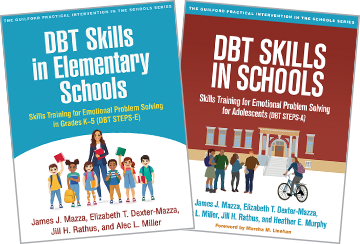
Skills Training for Emotional Problem Solving for Adolescents (DBT STEPS-A). Dialectical behavior therapy (DBT) skills have been demonstrated to be effective in helping adolescents manage difficult emotional situations, cope with stress, and make better decisions. From leading experts in DBT and school-based interventions, this unique manual offers the first nonclinical application of DBT skills. The book presents an innovative social-emotional learning curriculum designed to be taught by general education teachers or other school personnel in grades 6-12. Explicit instructions for teaching the skills—mindfulness, distress tolerance, emotion regulation, and interpersonal effectiveness—are provided in 30 lesson plans, complete with numerous reproducibles: 99 handouts, a diary card, and three student tests.
Additional outcomes:
Decreased anxiety
Strategies supporting educational equity (CASEL)
Not available at this time.
Implementation
Below are key implementation details for this program. These specifications help determine if the program is a good fit for your school or organization.
Grade(s)
High School (9-12), Middle (6-8)
Setting
Classroom, Schoolwide
Language
English
Cost
$45 per teacher manual
# Lessons
30+
Program Design
Tier 1 (Universal)
Technology Requirements
None
Staffing Requirements
None
Professional Development
Virtual online
Outcomes
Improved Academic Performance
Reduced Emotional Distress
Improved Identity Development/ Agency
Reduced Problem Behavior
Improved School Climate
Improved School Connectedness
Improved Prosocial Behavior
Improved Teaching Practices
Improved SEL Skills and Attitudes
Advocate for reducing stigma associated with emotional and mental and behavioral health
Compare & contrast emotional, mental-behavioral illness, mental well-being and concurrent disorders
Describe how self-harm or suicide impacts other people
Describe laws related to minors accessing mental health care
Explain how to help someone who is thinking about attempting suicide
Identify school and community resources that can help a person with emotional, mental and behavioral health concerns
Decreased suicidal behavior
Improved attitude/behavior related to suicide
Increased help-seeking behavior
Improved identification of individuals at-risk for suicide
Decreased substance use
Improved attitude/behavior related to substance use
Mental Health Literacy Components
This program addresses the following mental health literacy components:
Understanding stigma and strategies for stigma reduction
Understanding how to foster & maintain positive mental health
Understanding how to seek help effectively
Understanding common mental health disorders, signs and symptoms, and treatments
Evidence of Effectiveness
A quasi-experimental study with 72 female Irish high school students (15-16 years old) found that, for students receiving DBT STEPS-A intervention, there was a significant improvement with respect to two of the four outcome measures (Emotion Symptom Index and Internalising Problems). A statistically significant treatment effect for Emotion Symptom Index and Internalising Problems was also reported (p<.0125).
Published Studies
Flynn, D., Weihrauch, M., & Corcoran, P. (2018). Innovations in Practice: Dialectical behaviour therapy – skills training for emotional problem solving for adolescents (DBT STEPS-A): evaluation of a pilot implementation in Irish post-primary schools. Child and Adolescent Mental Health, 23(4), 376-380. https://doi.org/10.1111/camh.12284